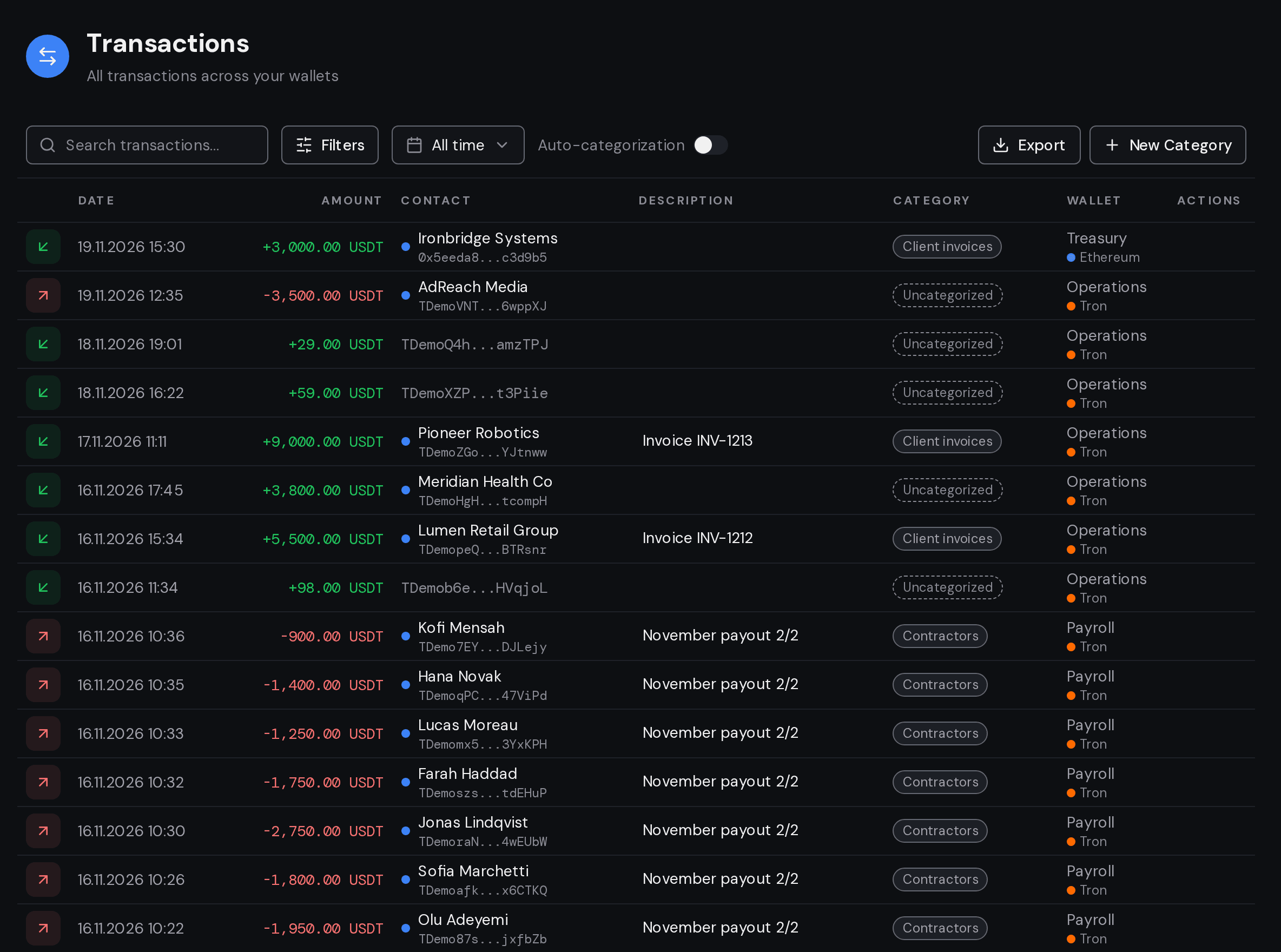
To reconcile crypto payments, compare two lists for the same period. The first is what you expected, from your invoices and payment requests. The second is what happened: the transfers into and out of your addresses on the blockchain. Every line of one list should match one line of the other. What does not match is what you look into.
This is a description of bookkeeping steps, not accounting or tax advice. Ask a qualified accountant about your own case.
What does it mean to reconcile crypto payments?
It means proving that your own records and the blockchain say the same thing. Your records say who owed what. The blockchain says which transfers took place. Reconciliation connects the two, line by line, until nothing is left over on either side.
What do you need before you start?
You need these for the period:
- The expected list: each invoice or payment request, with its amount, token, network and due date.
- The transfer list: every transfer of your addresses, with its date, amount, token, network, addresses and transaction hash.
- A list of your own addresses, so that you can recognize transfers between them.
- The balance of each address at the start of the period.
How do you match a payment to a transfer?
Match by the transaction hash when you have it, and by amount, token, network, date and sender when you do not. The transaction hash is the unique code of a transfer. Ask your payers to send it with every payment, because it settles the question at once.
Without a hash, work in this order:
- Look only at the transfers of the token and the network that the invoice names.
- Find the transfers of the exact amount.
- Keep the ones that fall near the due date.
- Confirm the sender. A known address of the client is a match. An unknown address is a question for the client.
When a line matches, write the invoice number on the transfer and the transaction hash on the invoice. Each one then points to the other.
Why does a payment not match?
A payment usually fails to match for one of the reasons in the table. Each has its own sign and its own fix.
| Reason | What you see | What to do |
|---|---|---|
| Paid on another network | Nothing arrived at the address you gave, but the payer has a transaction hash | Ask which network the payer used, and look at your address on that network |
| The amount differs | A transfer near the due date, slightly smaller or larger than the invoice | Ask the payer. A service on the payer's side may have kept a fee, or the payment is partial |
| An unknown sender | The right amount, from an address you have never seen | Ask the payer to confirm the address, then keep it under the payer's name |
| One transfer for several invoices | An amount that equals the sum of several invoices | Write every invoice number in the description |
| Several transfers for one invoice | Smaller amounts that add up to the invoice | Close the invoice only when the sum is complete |
| A transfer between your own addresses | A payment in that no client claims | Put the sending address on your list of own addresses. The transfer is internal |
| A transfer that nobody expected | No invoice, no request and no known sender | Keep it as an open item until you know what it is |
How do you check that nothing is missing?
Check the balance. Take the balance at the start of the period, add every incoming transfer and subtract every outgoing transfer. The result must equal the balance of the address at the end of the period, as the blockchain shows it. If it does not, your transfer list has a gap or a double row. Do this check for each address and each token.
A matched list and a correct balance together mean that the period is reconciled. Write down the open items that remain, with a note on each, and carry them into the next period.
How often should you reconcile?
Reconcile as often as payments could go wrong without notice. A desk that settles many payments a day checks every day. A small business with a few invoices can check once a month. The shorter the period, the easier each match is, because fewer lines look alike and people still remember the details.
What Chainbook does here
Chainbook holds the transfer side of the comparison, for USDT and USDC on TRON and Ethereum. Addresses are checked for new transfers every 10 minutes, so a payment appears after the next check and not at the moment it is sent. The ledger's search finds a transfer by its exact amount, its transaction hash, an address or a contact. Its filters narrow the list by wallet, contact, category, type and dates. There is no filter by token or by network, so filter by the wallet that holds the address. The page about the transaction ledger describes both.
Some of the work stays manual. The balance check for each address is done by hand. Chainbook does not hold your invoices and has no status for a reconciled transfer, so write the invoice number in the description. Descriptions have a limit on one plan: Free allows 20 descriptions in all, not per month; Pro has no limit. The type of a transfer cannot be edited. To have a transfer recognized as internal, add the other address to one of your wallets. The page for OTC desks and payment operators describes a daily check built on these parts.